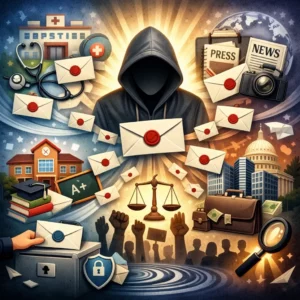
Whispers Without Names: The Hidden History of Anonymous Letters
Long before public speeches swayed crowds or reputations were built on recognition, influence often traveled in silence—folded into parchment, sealed without a name, and delivered with intent. Anonymous letters have shaped history not through identity, but through truth, timing, and courage.
Origins: When Silence Became a Voice
Anonymous correspondence dates back centuries, emerging in societies where speaking openly carried consequences. In monarchies, tightly controlled governments, and rigid social hierarchies, identity could be a liability. A name attached to dissent could mean exile, imprisonment, or worse.
Without signatures, however, words could travel freely.
These early letters were often slipped under doors, passed between trusted hands, or quietly circulated in public spaces. They carried accusations, warnings, political critiques, and private confessions—messages that would have otherwise remained buried.
Anonymity did not weaken the message. In many cases, it sharpened it.
Voices That Shaped Nations
History offers powerful examples of unsigned words altering the course of public discourse.
The Junius Letters stand among the most influential. Published in London newspapers, these letters fiercely criticized the British government and monarchy. Their author remains unknown to this day, yet their impact was undeniable—fueling political debate and emboldening public scrutiny of authority.
More than a century later, during the Dreyfus Affair, anonymous communication played a crucial role in exposing injustice. Accusations and counterclaims circulated without a clear origin, helping unravel a wrongful conviction rooted in prejudice and institutional failure. The controversy shook France and forced the nation to confront its own biases.
These were not just letters—they were catalysts.
Anonymity as Protection—and Power
In environments where power is concentrated, anonymity has long served as protection for those without it.
Servants wrote about their masters. Soldiers exposed their commanders. Citizens challenged their rulers.
Without a name attached, the focus shifted entirely to the content. The message stood on its own merit, free from assumptions about class, status, or reputation. In this way, anonymous letters quietly leveled the playing field.
They allowed truth to move upward—against hierarchy, against fear.
The Tradition of Whistleblowing
Long before the term existed, anonymous letters were one of the earliest tools of whistleblowers.
In courts, churches, and governments, unsigned accusations often triggered investigations. Corruption, misconduct, and abuse of power were frequently brought to light not by officials but by those who had everything to lose by being known.
Even in moments of global tension, anonymity proved pivotal. The release of sensitive truths, delivered without attribution, has repeatedly forced institutions to answer difficult questions and reckon with hidden realities.
These letters did more than inform—they demanded accountability.
Public Reaction: When Secrets Surface
When anonymous revelations reached the public, they rarely went unnoticed.
Crowds speculated. Leaders denied. Newspapers debated. And in many cases, pressure mounted until action became unavoidable.
Without a visible author to discredit, attention remained fixed on the substance of the claim. This often made anonymous letters uniquely difficult to dismiss. They lingered in the public mind, raising questions that could not easily be silenced.
At times, they sparked outrage. At others, reform.
But they almost always forced a response.
A Double-Edged Tradition
For all their power, anonymous letters have never been without risk.
The same shield that protects truth can also conceal falsehood. History holds examples of baseless accusations, personal vendettas, and misinformation spread under the cover of anonymity. Without accountability, credibility can become fragile.
Because of this, anonymous communication has always existed in tension—between revelation and suspicion, between courage and misuse.
Yet even with these risks, its role has endured.
A Practice That Endures
Across centuries, one truth remains consistent: people have always needed a way to speak when speaking openly was not an option.
Anonymous letters provided that path.
They gave voice to the overlooked, power to the cautious, and protection to the brave. They allowed individuals to confront injustice, express difficult truths, and influence events—without sacrificing their safety.
Today, that same principle continues in a more refined form.
Messages can still be written. Voices can still be heard. And identities can remain protected—not by chance, but by design.
Where once anonymity depended on secrecy and circumstance, it can now be carried out with intention—handled carefully, delivered thoughtfully, and kept completely separate from the sender.
Because sometimes, the most important words are the ones that stand alone.
Final Thought
Anonymous letters are not relics of the past. They are part of a long-standing human need—to speak freely when freedom is uncertain.
History proves one thing clearly:
A message does not need a name to matter.