
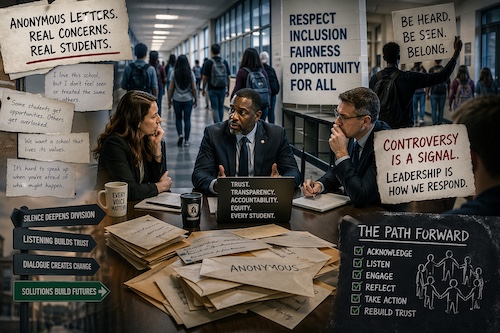
 There are moments in a school year that pass quietly—routine days filled with lessons, conversations, and growth. And then some moments shift everything.
Recently, within the walls of a local high school, a single set of remarks from school leadership has done just that—sparking concern, conversation, and a wave of quiet unrest that can no longer be ignored. What began as a moment has evolved into a broader question echoing through classrooms, homes, and community spaces alike:
Are all students truly being seen, heard, and treated fairly?
School administrators do more than manage schedules and enforce policies—they shape culture. Their words set the tone for how students feel when they walk through the doors each morning.
But when those words create division instead of unity, the impact is immediate.
Students have begun to express feelings of discomfort. Parents are asking harder questions. Community members are paying closer attention. For some, the concern is subtle—a shift in tone, an uneasiness. For others, it feels far more direct: a sense of being overlooked, misunderstood, or unfairly judged.
And yet, many of these voices share one thing in common:
They are hesitant to speak publicly.
In environments where power dynamics are real—and consequences can feel uncertain—anonymity becomes more than a preference. It becomes a necessity.
Anonymous letters have begun to surface. Thoughtful. Measured. Honest.
They are not attacks. They are not reckless accusations.
They are, instead, carefully written reflections from those who feel they have no other safe way to be heard.
Within these letters are recurring themes:
What makes these messages powerful is not just what they say—but the fact that they had to be said anonymously at all.
This is not simply about one comment or one moment. It is about trust.
When students begin to question whether their environment is truly supportive, the foundation of education itself is affected. When parents feel uncertain about the leadership guiding their children, confidence erodes. When a community senses imbalance, it looks for accountability.
The tension now present is not destructive by nature—it is a signal.
A signal that something needs attention.
A signal that voices are waiting to be acknowledged.
A signal that leadership must respond—not defensively, but decisively.
The path forward is not complicated—but it does require courage.
It would be easy to dismiss anonymous letters as uncertain or incomplete.
That would be a mistake.
Anonymity does not weaken a message—it often reveals the conditions under which that message had to be written.
When individuals feel they cannot safely attach their names to their experiences, that reality deserves attention in itself.
Protecting anonymous communication:
In this case, these letters are not a disruption—they are a doorway.
The strength of a school is not measured by the absence of conflict, but by how it responds to it.
This moment, while difficult, presents an opportunity:
Leadership is not defined by perfection—it is defined by accountability, growth, and the willingness to act when it matters most.
Behind every anonymous letter is a person who paused, reflected, and chose to speak—carefully, cautiously, but purposefully.
That choice deserves respect.
Because sometimes, the most important conversations don’t begin with a name.
They begin with the courage to be heard…
even when no one knows who is speaking.