
 There are moments in a community that don’t arrive with noise—but with a shift. A pause in conversation. A glance was exchanged in the hallways. A question that lingers just a little too long.
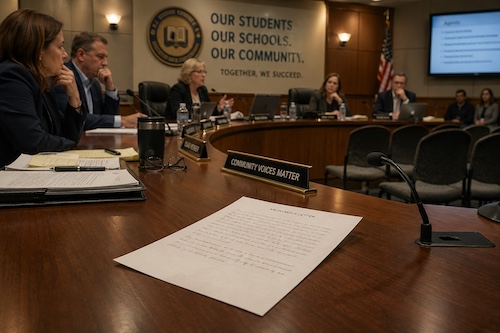
What began as a single moment at a recent school board meeting has since grown into something far larger. It has spread beyond that room—into classrooms, into homes, into quiet conversations among parents, staff, and students. What was once contained is now echoing across the community.
And people are starting to ask: Are we being heard?
On Monday night, a moment unfolded that many cannot ignore. An anonymous letter—one that raised concerns about district decision-making, financial management, class sizes, and school construction—was dismissed outright.
Set aside.
Deemed unworthy of consideration because it lacked a name.
At first glance, that decision may seem procedural. Practical, even. But beneath the surface, it struck something deeper. Because in that moment, it wasn’t just a letter that was dismissed—it was the possibility that some voices only feel safe when they are not seen.
And now, the silence left behind is speaking volumes.
It’s easy to question anonymity. To doubt it. To challenge its credibility.
But in many communities—especially close-knit ones—anonymity is not about deception. It’s about protection.
Not everyone feels safe attaching their name to criticism. Not when their child is in the system. Not when their job may depend on staying quiet. Not when speaking openly could carry consequences.
So they write anonymously.
Not because they don’t care—but because they care enough to speak, even when it’s difficult.
Dismissing those voices doesn’t eliminate the concerns. It simply buries them. And buried concerns have a way of resurfacing—stronger, louder, and often too late.
There’s a reason the tension feels different now.
When people feel unheard, trust begins to erode. Slowly at first. Then all at once.
What we’re witnessing is not outrage—it’s something quieter, and in many ways more powerful: a growing sense of disconnect. A feeling that the gap between leadership and community is widening.
This is how communities begin to “melt.”
Not through chaos, but through disconnection.
Through missed opportunities to listen.
Through moments where dialogue could have been invited—but wasn’t.
Through decisions that feel closed off rather than collaborative.
Ignoring anonymous feedback may feel like maintaining order—but in reality, it risks creating blind spots.
Because within those unsigned messages can be patterns. Warnings. Insights that might not surface in public forums.
When school boards listen only to voices that feel safe to speak publicly, they may only be hearing part of the story.
And partial understanding leads to incomplete solutions.
Students feel it.
Teachers carry it.
Families notice it.
The cost isn’t immediate—but it is cumulative.
True leadership is not about filtering voices—it’s about understanding them.
Yes, not every anonymous message will be fair. Not every claim will be accurate. But that doesn’t mean they should be ignored. It means they should be examined with care, context, and responsibility.
Because when people take the time to write—even anonymously—they are reaching out. They are asking, in the only way they feel they can:
“Will you listen?”
Answering that question with openness rather than dismissal is where trust begins to rebuild.
This moment is not beyond repair. In fact, it presents an opportunity.
An opportunity for the school board to lead differently.
To invite—not avoid—uncomfortable conversations.
To create space where all voices, named or unnamed, are acknowledged.
Transparency is not just about what is shared—it’s about how people are allowed to speak.
When a community feels heard, it becomes stronger.
When trust is nurtured, collaboration follows.
When dialogue is open, solutions become possible.
The answer is not silence.
The answer is not dismissal.
The answer is dialogue.
If this community is to move forward, it must do so with intention—by recognizing that every voice carries value, even the ones that arrive without a signature.
Because in the end, a school district does not thrive by deciding who gets to be heard.
It thrives by listening to everyone.
And right now, more than ever—
Our community is waiting.