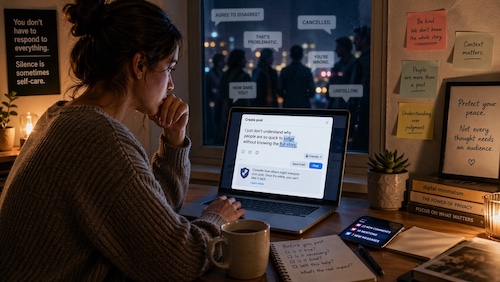
 Cancel Culture Isn’t Dead—It’s Just Moved Closer to Home
For a while, it seemed like cancel culture was fading.
Headlines shifted. Public figures who once faced intense backlash began to recover more quickly—or never truly fell at all. The narrative changed: “Cancel culture is over.” But that conclusion misses something important.
Cancel culture didn’t disappear. It adapted. And in many ways, it has become more deeply embedded in everyday life—especially for people without influence, protection, or a platform to defend themselves.
The Illusion of Decline
At the celebrity level, consequences appear softer than they once did. Public figures now often weather controversy with carefully managed responses, loyal audiences, and well-funded support systems. A misstep might trigger outrage, but it rarely leads to permanent erasure.
This creates the illusion that society has moved past cancel culture—that we’ve collectively decided to be more forgiving, more nuanced, more measured.
But that perspective is shaped by visibility. What we see at the top doesn’t reflect what happens everywhere else.
A Different Reality for Everyday People
For most people, there is no PR team. No strategic apology. No second wave of support to counterbalance criticism.
Instead, consequences can be immediate and deeply personal.
A single post, comment, or misunderstood statement can lead to:
- Job loss or workplace discipline
- Social isolation within communities or friend groups
- Damage to personal reputation that lingers indefinitely
- Harassment or public shaming without context
Unlike public figures, everyday individuals don’t have the tools to recover at scale. There’s no algorithm pushing their side of the story. No media cycle to move attention elsewhere. What remains is often silence—and fallout.
The Rise of Quiet Self-Censorship
One of the clearest signs that cancel culture is still active isn’t what people are saying—it’s what they’re choosing not to say.
Across social and professional spaces, many individuals have become more cautious. They weigh their words carefully, avoid certain topics entirely, or choose not to engage at all. Not because they have nothing to contribute—but because the potential cost feels too high.
This is where cancel culture has evolved most significantly.
It’s no longer just about public callouts. It’s about the anticipation of them.
That anticipation creates a kind of pressure—subtle, but persistent. A sense that one wrong phrase, taken out of context, could trigger consequences that are difficult to reverse.
When Accountability Becomes Unpredictable
At its best, accountability is necessary. It helps define boundaries, reinforces standards, and gives people a way to address harm.
But the current landscape often blurs the line between accountability and reaction.
Context is frequently compressed. Intent becomes secondary to interpretation. And responses can escalate quickly, shaped more by momentum than by careful understanding.
For everyday individuals, this unpredictability matters. Without a platform to clarify or correct, even minor situations can take on an outsized impact.
The Power Imbalance No One Talks About
There’s a growing divide between those who can absorb public scrutiny—and those who cannot.
Public figures often operate with:
- Financial stability
- Established audiences
- Professional guidance
- Opportunities to reframe their narrative
Every day people, by contrast, operate with:
- Limited visibility
- Fewer resources
- Immediate real-world consequences
- Little to no control over how they’re perceived once something spreads
This imbalance doesn’t just shape outcomes—it shapes behavior. It determines who feels safe speaking openly and who chooses to stay quiet.
The Digital Crowd Effect
Social platforms have made it easier than ever for large groups to respond quickly—and emotionally.
What begins as a single comment can evolve into widespread criticism within hours. Not always because of intent, but because of amplification. The speed of response often outpaces the time needed for reflection.
For individuals caught in that moment, the experience can feel overwhelming. There is rarely a clear path to resolution, only a wave that must be endured.
And while attention eventually moves on, the digital footprint often remains.
Why This Still Matters
The conversation around cancel culture often focuses on whether it’s justified, exaggerated, or politically motivated. But for many people, the question is simpler:
Is it still affecting how we communicate, express ourselves, and interact with others?
The answer, increasingly, is yes.
Not always loudly. Not always publicly. But consistently—in small decisions, in hesitation, in the quiet filtering of thoughts before they’re shared.
A More Thoughtful Way Forward
If cancel culture has changed, then the response to it must change as well.
This doesn’t mean avoiding accountability. It means creating space for context, for intention, and for measured response instead of immediate reaction.
It also means recognizing that not everyone enters the conversation with the same level of protection.
For many, the ability to speak openly still carries risk.
And in that reality, finding ways to communicate thoughtfully—sometimes even privately or anonymously—becomes less about avoidance, and more about balance.
Cancel culture isn’t gone.
It’s simply closer than it appears.