
 Living close to others is a shared experience—one that brings both connection and, at times, friction. Thin walls, shared spaces, and different lifestyles can easily lead to tension, especially when it comes to noise and everyday habits. A late-night gathering, a barking dog, or even enthusiastic gaming sessions can quickly turn a peaceful evening into a frustrating one.
But most neighbor conflicts don’t begin with bad intentions—they begin with unawareness.
That’s why the way we respond matters just as much as the issue itself.
Noise is one of the most common sources of neighbor conflict. What feels normal to one person—a weekend party, children playing, music after work—can feel overwhelming to someone next door seeking rest. The challenge lies in the invisible line between personal freedom and shared responsibility.
Other common issues often follow a similar pattern:
In nearly every case, the root issue isn’t just the behavior—it’s the lack of communication around it.
Resolving these situations begins with a simple but often overlooked step: seeing the situation from the other side.
If you’re being affected, it helps to remember that your neighbor may not realize there’s a problem. If you’re the one being approached, it’s important to understand that raising a concern is often uncomfortable and not done lightly.
A calm, respectful tone can prevent a small issue from becoming a lasting conflict. But even with the best intentions, direct conversations aren’t always easy. Timing, personality differences, or fear of confrontation can make speaking face-to-face feel overwhelming.
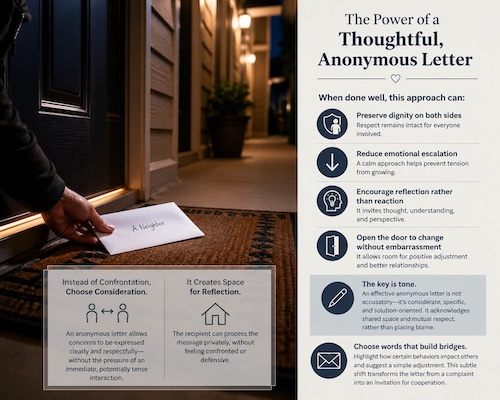
This is where anonymous letter writing becomes a powerful, thoughtful alternative.
An anonymous letter allows concerns to be expressed clearly and respectfully—without the pressure of an immediate, potentially tense interaction. It creates space for the recipient to process the message privately, without feeling confronted or defensive.
When done well, this approach can:
The key is tone. An effective anonymous letter is not accusatory—it’s considerate, specific, and solution-oriented. It acknowledges shared space and mutual respect, rather than placing blame.
For example, instead of focusing on frustration, the message might gently highlight how certain behaviors impact others and suggest a simple adjustment. This subtle shift transforms the letter from a complaint into an invitation for cooperation.
Every neighborhood is a small ecosystem. Each person brings their own routines, preferences, and expectations. Conflict isn’t a sign that something is wrong—it’s a sign that people are living closely together.
What defines a healthy community is not the absence of conflict, but the way it’s handled.
By approaching issues with empathy, choosing words carefully, and sometimes opting for indirect yet thoughtful communication like anonymous letters, it becomes possible to protect both peace and relationships.
At its core, neighborly harmony isn’t about silence or perfection—it’s about awareness.
It’s about recognizing that small adjustments can make a big difference in someone else’s daily life. It’s about choosing understanding over assumption. And sometimes, it’s about finding quieter, ավելի respectful ways to speak when speaking feels difficult.
Because in shared spaces, the goal isn’t just to live—it’s to live well, together.